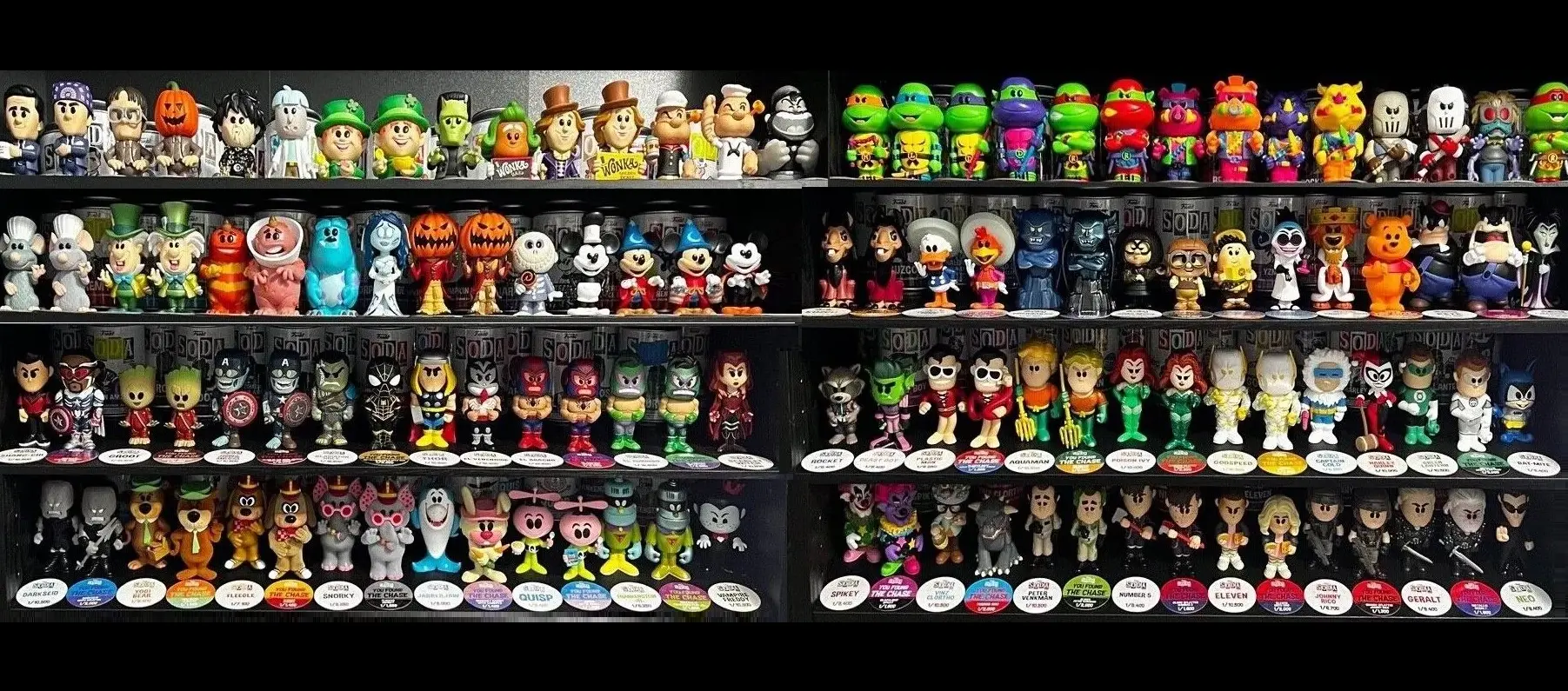
When Funko launched the SODA line around ECCC 2020, they made something genuinely unique: figures packed in actual aluminium soda cans, complete with mystery chase variants you could only find by cracking the can open. Add limited-edition numbering and you had a brand-new collecting ritual — part figure, part scratchie. For a while it was magic.
Then, by late 2023, the rumours started: Funko might be winding the whole line down. To understand how we got here, you have to follow the full journey of one of Funko's most innovative — and ultimately most troubled — product lines.
The Golden Era: When SODAs Were King (2020–2022)
The Revolutionary Concept
The original formula was deceptively simple but brilliant:
- Aluminium can packaging that mimicked real soda cans.
- Limited edition numbering (typically LE 2,000 to LE 10,000).
- Mystery chase variants hidden inside select cans.
- "Funko DNA" licenses: classic characters from beloved franchises.
- An affordable entry point compared to other limited collectibles.
The Limited-Edition Magic That Drove Early Success
Early releases ran a carefully crafted scarcity model — mostly LE 2,000 to LE 10,000 — that created real urgency. The numbering made each can feel special; collectors would check their edition number and celebrate a low pull. And above the standard runs sat the legends:
- Convention exclusives: LE 250 (Golden Sleestak) and LE 300 (Pizza Freddy Funko).
- Chase variants: often just 300 pieces across all retailers.
- Fundays team exclusives: LE 400 per team — only 1,600 total across four teams.
- Artist Proof (AP) cans: the holy grail, roughly 24–36 pieces per release.
- Ultra-rare Fundays specials: the legendary LE 24 possibilities collectors dreamed about.
The Artist Proof Mystery: SODA's Best-Kept Secret
The most exclusive — and most misunderstood — category is the Artist Proof. These are the pinnacle of SODA collecting:
- Extremely limited: an estimated 24–36 pieces per release.
- Superior paint quality: hand-finished or first-run production, with cleaner lines and more vibrant colours.
- Exclusive distribution: only given away at Funko events, conventions and special promotions.
- Unique ID: a special "AP" pog (the circular cardboard disc inside the can).
- No retail availability: never sold in stores — pure giveaway prizes.
The catch: unlike numbered editions, APs can only be identified by their pog and superior paint — and pogs can be faked. Experienced collectors look for the tell-tale signs of higher-quality paint (cleaner lines, better saturation, more precise detail), which is exactly the kind of close-inspection skill our guide to spotting fakes trains. APs surfaced at Star Wars Celebration events, Funko HQ "Soda Saturdays," Festival of Fun giveaways, convention booth prizes and special promos.
International Challenges That Foreshadowed Problems
Even at the peak, warning signs were there. International collectors faced real barriers:
- Shipping costs: $30+ per SODA in Australia, thanks to the weight.
- Limited distribution: many releases never reached international markets.
- Currency conversion: made already-pricey SODAs prohibitive.
- Chase odds: overseas collectors couldn't afford to buy multiples to chase-hunt.
The Turning Point: When Scarcity Died (2022–2023)
The decline traces back to a handful of business decisions that changed what made the product special:
- 1. The death of LE numbering. Unnumbered/unlimited releases marked the beginning of the end — where early runs commanded attention with LE 2,000–10,000 counts, new ones eliminated scarcity entirely.
- 2. Price rises without added value. Costs went up while exclusivity went down — the worst possible combination for collectors.
- 3. Market oversaturation. The schedule accelerated, multiple lines launched at once, and "SODA fatigue" set in.
- 4. Retail strategy failure. Mass retail meant SODAs sat on shelves indefinitely, killing the urgency that drove early adoption.
The Psychology of Collecting: Why Numbers Matter
Unlimited releases exposed a fundamental truth: perceived scarcity drives desire. Take away the edition number and the thrill of a low pull, and the whole experience loses its emotional hook. Chase hunting disappeared (why buy six unlimited cans when the chase will hit the secondary market anyway?), opening excitement vanished, the investment mindset faded, and community chatter dwindled without scarcity to discuss.
The Current Crisis: Symptoms of a Dying Line (Late 2023)
By late 2023, insiders were noticing trouble: backend systems showing inventory modifications, fewer new SODA announcements, retailers reporting poor turnover, and collector enthusiasm at all-time lows.
The Bitty Pop Factor: A Cheaper Alternative Takes Over
The rise of Bitty Pops as SODA's main competitor revealed what consumers actually wanted: a lower price point per unit and on shipping, space efficiency (stackable, easy to display), a big weight advantage for international buyers, novelty appeal in the booming miniature market, and lines small enough to feel completable. Collector reports from retail consistently show Bitty Pops outselling SODAs — even during SODA's peak — which likely fed Funko's rumoured decision to wind the line down. (We covered Bitty's breakout in our look at Funko's 2025 numbers.)
Incomplete Lines: The Collector's Nightmare
One of the most frustrating parts of a potential discontinuation is the unfinished sets it leaves behind:
- TMNT: missing key characters like Master Splinter and April O'Neil.
- Scooby-Doo: an incomplete Mystery Inc. gang.
- Cowboy Bebop: no Jet Black to complete the crew.
- KISS: an unfinished band lineup.
- Teen Titans: missing core team members.
- Hanna-Barbera: multiple incomplete classic-cartoon sets.
For collectors who bought into a franchise expecting a full roster, these represent failed investments — the opposite of a satisfying chase.
Industry Implications: Lessons for Collectible Markets
The SODA story demonstrates a few crucial principles. The successful formula needs perceived scarcity to drive demand, exclusivity to maintain value, community-building through shared hunting, and international accessibility via affordable entry points. The cautionary note: Funko's pattern with SODAs mirrors discontinued lines like Dorbz — initial success leading to oversaturation and decline, where maximising short-term profit through increased production undermines long-term value.
Price Sensitivity in Collectible Markets
- Affordability thresholds: once prices exceed a point, casual collectors exit.
- Chase economics: if buying multiples gets too expensive, chase hunting dies.
- International factors: shipping costs alone can kill entire markets.
- Opportunity cost: collectors will pick a cheaper alternative that delivers similar satisfaction.
Future Scenarios: What Comes Next?
- 1. Complete discontinuation (most likely). Following the Dorbz precedent of ~4 years before cancellation, SODAs may simply end — leaving incomplete lines forever unfinished.
- 2. Convention/event exclusives only. A scaled-back approach: LE 400–500 per team at Fundays, convention-only releases, special event giveaways, and APs maintained.
- 3. Complete reboot. A return to first principles: mandatory LE numbering, smaller runs (LE 1,000–5,000 max), higher prices justified by genuine scarcity, and completing existing lines before starting new ones.
- 4. Evolution to Bitty SODA. Funko showed mini SODA cans at their 2022 investor event, hinting at a smaller, cheaper format that addresses shipping and display concerns.
The Ultra-Limited Hope
Plenty of collectors hope SODA survives by returning to its ultra-limited roots — and the community has proven it'll pay premium prices for genuine scarcity, evidenced by ongoing demand for early low-numbered releases and APs. The wishlist: LE 500–1,000 max runs, more Artist Proofs at events, completion of existing lines before new launches, special LE 24–48 pieces for major events, and a restoration of that numbered-edition excitement.
Conclusion: A Cautionary Tale of Innovation and Mismanagement
At its peak, SODA offered genuine innovation — nostalgic packaging, mystery elements and carefully managed scarcity rolled into one experience, with APs and ultra-limited convention releases building passionate communities around the hunt. But abandoning those core principles for short-term sales growth shows how fast a beloved line can lose its magic. Going from LE 2,000 numbered releases to unlimited runs didn't just change the economics — it changed how it felt to collect.
Whether SODAs survive in some form or join Dorbz in the archive, the lesson is clear: in collectibles, scarcity isn't only about supply and demand — it's about protecting the dreams and excitement that get people collecting in the first place. There's bitter irony for current owners: the very uncertainty may make existing SODAs — especially APs and low-numbered early releases — more valuable than ever. If you're chasing the rarest event pieces, see what genuine scarcity looks like at Funko Fundays 2025.
Collector's Quick Reference
SODA Rarity Hierarchy (Most to Least Rare)
- Artist Proof (AP) variants — 24–36 pieces.
- LE 24 Fundays specials — theoretical ultra-rares.
- Convention exclusives — LE 250–300.
- Chase variants — LE 300–500.
- Fundays team exclusives — LE 400 per team.
- Early numbered releases — LE 2,000–5,000.
- Later numbered releases — LE 10,000+.
- Unlimited releases — no scarcity value.
Red Flags for AP Authentication
- Prices significantly below market value.
- Sellers with no event-attendance history.
- Poor-quality photos hiding paint details.
- Unwillingness to provide provenance.
- Pogs that look freshly printed or misaligned.
Investment perspective: early numbered SODAs and APs likely hold long-term value best, especially if the line is discontinued — unlimited releases offer minimal upside regardless. To put any of these in context, lean on our rarity, grading and price guide and the box condition grading guide.