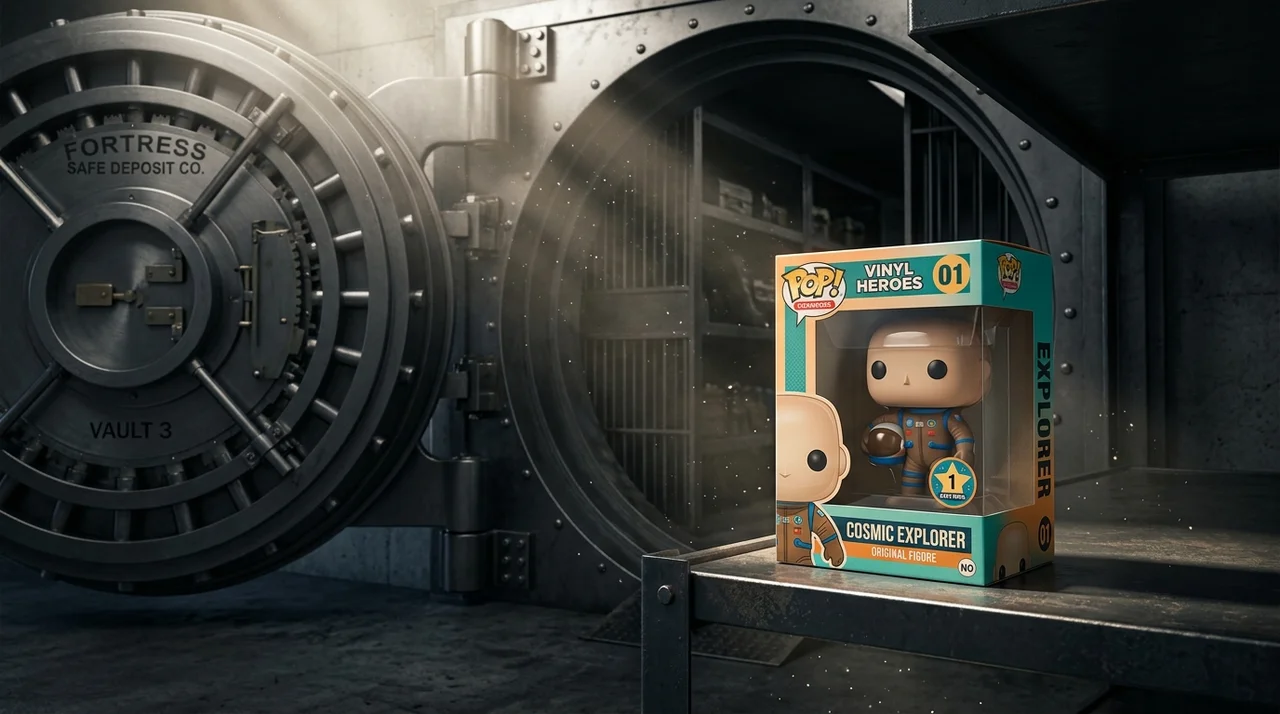
Somewhere in Everett, Washington, there is — metaphorically speaking — a great steel door. When Funko decides a Pop's run is over, the figure goes behind it: production stops, moulds are retired, and no more will ever be made. That's vaulting. It's the single most important word in Funko economics, and one of the most misunderstood. Here's what it actually means, what it does to prices, and the catch nobody mentions.
What Vaulting Actually Means
'Vaulted' is Funko's official term for discontinued. Not sold out, not on backorder, not 'between print runs' — finished. The supply of that figure is now permanently fixed at however many exist in the world today, minus every one that gets dropped, faded, flooded, or chewed by a dog from here on. Funko releases thousands of new figures a year and shelf space is finite, so the vault is constantly swallowing older releases to make room. Most Pops live roughly a year or two at retail before their number is up.
Why Funko Vaults Figures
Three reasons, usually overlapping. Licences expire — when a deal with a film studio or a band lapses, production legally must stop. Sales slow — shelf space goes to what's selling. And, candidly, scarcity is the engine of the whole collectible machine: a hobby where everything stayed in print forever would have no hunt, and the hunt is the point. The vault is what turns a mass-produced toy into a finite artefact.
What Vaulting Does to Value (The Honest Version)
Here's where new collectors get burned: vaulted does not mean valuable. Vaulting fixes supply — that's all. Value needs the other half of the equation: demand. A vaulted Pop of a character people love, from a franchise still culturally alive, can climb steadily for years. A vaulted Pop from a forgotten licence just becomes a discontinued toy. The pattern repeats across the hobby: demand decides, scarcity amplifies. Our rarity, grading and price guide digs into how to weigh both — and why condition multiplies everything (a vaulted grail in a crushed box is a tragedy with a discount).
How to Tell if a Pop Is Vaulted
- The Funko app and official product pages mark vaulted status on most figures.
- Retail availability is the practical tell: if no official retailer can stock it and only the secondary market has it, it's almost certainly vaulted.
- Price guides and sold-listing histories show the moment supply stopped — a flat retail price that starts drifting upward is the vault's signature.
- Check the figure on our database — secondary-market pricing on a years-old release tells the story at a glance.
The Catch: The Vault Door Opens Both Ways
Nobody mentions this part until it costs them money: Funko can unvault. Re-releases happen — anniversary editions, renewed licences, greatest-hits reprints — and when a figure comes back, the original's scarcity premium can deflate overnight. Sometimes the re-release differs slightly (new box, new number) and the original keeps a collector's premium; sometimes it's near-identical and the market simply corrects. The lesson is the same one Funko SODA taught when its limited-edition numbering disappeared: scarcity is a promise, and promises from manufacturers are revocable. Never pay a price that assumes the vault is forever.
Should You Buy Before the Vault?
Funko occasionally announces vaulting in advance, and 'last chance' lists do the rounds. Buying a figure you love before it vanishes at retail price? Always sensible — that's just shopping with good timing. Panic-buying figures you don't care about because a list said so? That's the FOMO tax, and the secondary market is littered with vaulted commons worth less than their original retail. Buy the ones that belong in your story. The vault will take care of the rest.
New to all of this? Start with our beginner's guide, decode any term in the glossary, and learn the sticker system — the vault's partner in scarcity — in our sticker guide.